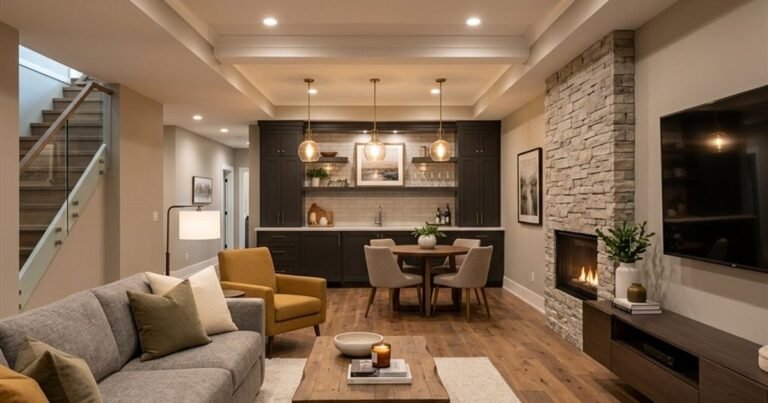
Basement waterproofing before finishing is the step that decides whether your new basement lasts five years or twenty-five. In Toronto, where many older homes sit on clay soil, have aging foundations and face heavy spring melt and summer storms, a basement that was dry for years can suddenly leak. Putting drywall, insulation and flooring over an active problem is the most expensive mistake in basement renovation. This checklist walks you through what to look for, what the fixes are and how to confirm the job is done before you build.
Basement waterproofing before finishing: signs moisture is getting in
Before you plan finishes, spend an afternoon looking. Check every wall and the floor, with a flashlight, in the corners and behind storage.
- White, chalky deposits on concrete or block, called efflorescence, which signal water moving through the wall.
- Dark stains or tide marks at the base of walls.
- A musty smell, especially after rain, which suggests ongoing dampness.
- Peeling paint, flaking concrete or bubbling coatings.
- Rust on the bottom of the furnace, water heater legs, metal columns or the laundry equipment.
- Cracks in walls or floors, particularly horizontal cracks, stair-step cracks in block, or cracks that weep after rain.
- Water around the floor drain or sump pit after heavy rain or snowmelt.
Note the date and the weather when you see signs. Water that appears only after a downpour points to a different cause than constant dampness.
Find the source before choosing a fix
Water enters in a handful of ways: surface water from poor grading, downspouts that dump next to the house, window wells that fill, cracks and cold joints in the foundation, failed or clogged weeping tile, and groundwater that pushes up through the slab. Condensation can mimic a leak, since humid summer air hitting cool concrete creates damp patches on its own.
Start outside. Make sure the soil slopes away from the foundation and downspouts discharge well away from the wall. Check that window wells drain and are not full of leaves. Many problems are solved here, and the cost is far lower than any excavation. Then look inside, and bring in a qualified contractor for anything that is not clearly a simple surface issue.
Interior or exterior waterproofing
Each approach has trade-offs, and the right choice depends on the cause and the house.
Exterior waterproofing means excavating around the foundation, repairing the wall, applying a membrane, adding drainage board and renewing the weeping tile. It treats the problem at its source and protects the foundation, but it is disruptive, can be limited by access, decks, fences and neighbouring structures, and costs more.
Interior solutions include a drainage channel along the perimeter that directs water to a sump pit, plus crack repair and wall coatings or membranes. They are less disruptive and can be done in more situations. They manage water that gets in rather than keeping it out entirely, so the sump and pump must be reliable.
Ask your contractor which approach they recommend and why, what is guaranteed and how performance will be checked. If the answer is only a coating on the wall, be cautious, because paint-on products do not fix an active water source.
Sump pump and weeping tile
Weeping tile is the perforated pipe around the footing that collects groundwater and carries it away. Older tiles can be clogged with silt, collapsed or poorly connected. A camera inspection can show their condition. If the system relies on a sump pump, confirm that the pump is the right size, the pit is clean, the discharge goes outside and away from the house, and the pump has a check valve. Think about backup power or a battery backup, since storms that overload drainage also tend to knock out the power.
Membrane and wall systems inside the finished basement
Even a basement that is dry in general benefits from a layer between the concrete and your finished walls. A dimpled membrane on the foundation wall creates an air gap that lets stray moisture drain down and dry rather than soak into framing and insulation. Framing should sit slightly off the concrete wall, and the bottom plate should be pressure-treated or separated from the slab. Insulation must be chosen for basement conditions, since fibreglass against a damp wall can hold moisture.
For floors, choose finishes that tolerate dampness, such as vinyl plank, porcelain tile or products designed for use on slab. A subfloor system with a dimpled layer can help, and carpet directly on concrete is a risk. These details belong in the overall plan, and our basement renovation page shows how we sequence them.
Testing before you cover anything
- Wait through at least one heavy rain or thaw after the waterproofing work, if the schedule allows, and inspect the walls and floor.
- Check the sump pit, run the pump and watch that it discharges properly.
- Use a moisture meter on the walls and slab at several points, and keep a record.
- Look for new efflorescence or damp spots.
- Only then book framing and insulation.
If your basement is in an older Etobicoke home with low ceilings or you are considering underpinning at the same time, waterproofing and drainage are usually handled together, as discussed on our Etobicoke basement renovation page. Remember that waterproofing adds to the overall budget. Our basement renovation cost guide explains how it affects totals, and as a typical range a recreational basement finish runs about $35,000-$65,000, although every home differs and a site visit gives the real number.
Frequently Asked Questions
Can you finish a basement that has a small leak?
You should fix the source first. Finishing over a leak leads to mould, damaged materials and a second renovation.
Is a dehumidifier enough?
It helps with humidity but does not stop liquid water entering through walls or the floor.
Does waterproofing need a permit?
Some work, such as excavation, foundation repair or changes to drainage connections, may. Confirm with the City of Toronto.
How do you know when it is safe to start framing?
When the source is corrected, the surfaces test dry and the basement has gone through rain or thaw without new signs of moisture.
If you want to be sure about basement waterproofing before finishing in Toronto, call us at 647-914-2150 or book a free site visit. GoGajic Construction, 131 Minerva Ave, Toronto, will check your walls and floor and tell you what needs to happen before any finishing starts.